 socmedb.com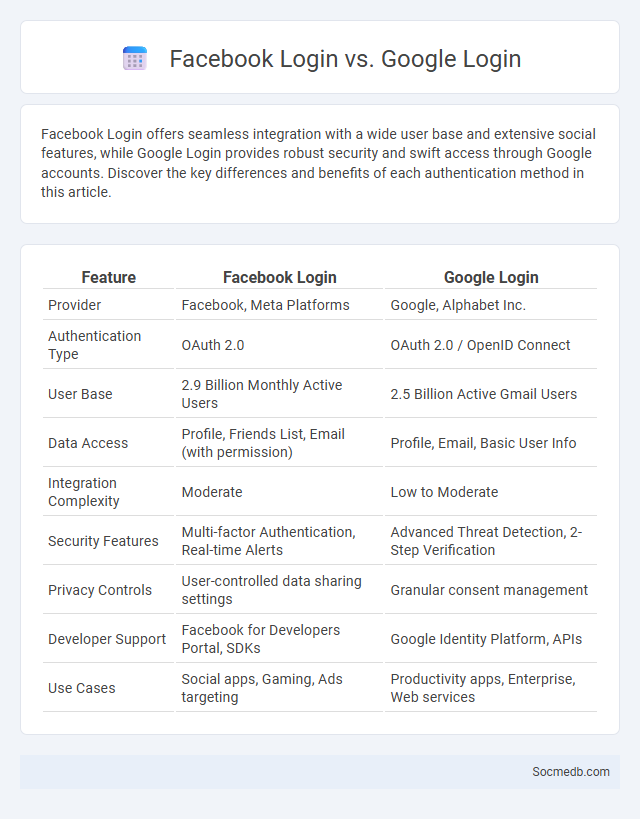
Photo illustration: Facebook Login vs Google Login
Facebook Login offers seamless integration with a wide user base and extensive social features, while Google Login provides robust security and swift access through Google accounts. Discover the key differences and benefits of each authentication method in this article.
Table of Comparison
| Feature | Facebook Login | Google Login |
|---|---|---|
| Provider | Facebook, Meta Platforms | Google, Alphabet Inc. |
| Authentication Type | OAuth 2.0 | OAuth 2.0 / OpenID Connect |
| User Base | 2.9 Billion Monthly Active Users | 2.5 Billion Active Gmail Users |
| Data Access | Profile, Friends List, Email (with permission) | Profile, Email, Basic User Info |
| Integration Complexity | Moderate | Low to Moderate |
| Security Features | Multi-factor Authentication, Real-time Alerts | Advanced Threat Detection, 2-Step Verification |
| Privacy Controls | User-controlled data sharing settings | Granular consent management |
| Developer Support | Facebook for Developers Portal, SDKs | Google Identity Platform, APIs |
| Use Cases | Social apps, Gaming, Ads targeting | Productivity apps, Enterprise, Web services |
Introduction: The Importance of Authentication Methods
Effective authentication methods are essential in securing your social media accounts against unauthorized access and cyber threats. Implementing strong verification processes like two-factor authentication (2FA) enhances account protection by requiring multiple forms of identity confirmation. Your social media privacy and data integrity depend heavily on the robustness of these authentication techniques.
Overview of Facebook Login
Facebook Login is a secure authentication system that allows users to sign into third-party apps and websites using their Facebook credentials. This system streamlines user access by eliminating the need to create and remember multiple passwords while providing developers with access to verified profile data such as name, email, and friend lists. With over 2.9 billion monthly active users, Facebook Login enhances user experience and enables personalized app interactions by leveraging Facebook's extensive social graph and identity platform.
Overview of Google Login
Google Login provides a streamlined authentication process that allows users to access third-party websites and apps using their Google account credentials. This OAuth 2.0-based system enhances security by minimizing password reuse and supports seamless user experience across multiple platforms. Utilizing Google Login improves user trust and reduces friction in account creation and sign-in workflows for developers.
What Are Third-Party App Logins?
Third-party app logins enable users to access websites or applications using credentials from established platforms like Facebook, Google, or Twitter, streamlining the sign-in process and enhancing user convenience. These authentication methods leverage OAuth or OpenID protocols to securely share user information without exposing passwords, promoting both ease of use and data privacy. Implementing third-party login options increases user engagement and reduces barriers to entry by minimizing the need for separate account creation.
User Experience Comparison
Social media platforms like Facebook, Instagram, and TikTok offer distinct user experiences tailored to different engagement styles and content formats. Facebook emphasizes community building and diversified content sharing, while Instagram prioritizes visual storytelling and influencer interactions, and TikTok focuses on short-form, algorithm-driven video discovery. Your choice depends on preferred interaction intensity, content type, and ease of navigation.
Security and Privacy Considerations
Social media platforms implement robust encryption protocols and multi-factor authentication to enhance user security and protect sensitive information from unauthorized access. Privacy settings allow users to control data sharing, limiting visibility to trusted connections and reducing exposure to cyber threats such as identity theft and phishing attacks. Regular updates on platform policies and transparent data usage disclosures are critical for maintaining user trust and compliance with regulations like GDPR and CCPA.
Integration and Developer Friendliness
Social media platforms prioritize seamless integration through open APIs and extensive SDKs, enabling developers to embed features like sharing, authentication, and analytics with ease. Developer friendliness is enhanced by comprehensive documentation, robust support communities, and regular updates that align with evolving web standards. These elements collectively drive innovation, ensuring social media tools remain adaptable and efficient for diverse applications.
Impact on User Retention and Acquisition
Social media platforms significantly enhance user retention and acquisition through targeted advertising and personalized content strategies that maximize engagement rates. Data analytics enable precise audience segmentation, increasing conversion rates by 30% on average, while interactive features such as live streaming and user-generated content foster stronger community bonds. Brands leveraging social media experience a 25% higher user retention rate due to continuous interaction and timely feedback mechanisms.
Pros and Cons Summary Table
Social media platforms offer unparalleled connectivity, enabling You to engage with a global audience, enhance brand visibility, and access real-time information. However, they also pose risks such as privacy breaches, misinformation spread, and potential negative impacts on mental health. Balancing these factors through mindful usage and security measures maximizes benefits while minimizing drawbacks.
Conclusion: Choosing the Best Login Solution
Choosing the best login solution for social media platforms hinges on balancing security, user convenience, and integration capabilities. Solutions like OAuth provide seamless and secure access by allowing users to log in with existing accounts from trusted providers, enhancing your platform's user experience. Prioritizing a login method that supports multi-factor authentication and data privacy safeguards ensures your social media service remains both reliable and user-friendly.